Tampa Bay structural foundations experience chronic subterranean pressure due to humid coastal conditions, high water tables, and sprawling fungal-rich sandy soils. A proper defense relies on establishing an…
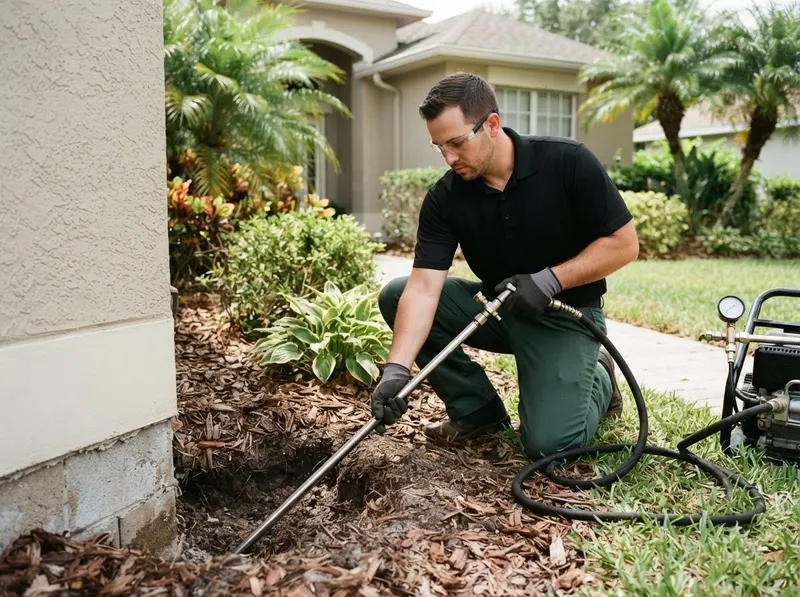
Tampa Bay structural foundations experience chronic subterranean pressure due to humid coastal conditions, high water tables, and sprawling fungal-rich sandy soils. A proper defense relies on establishing an uninterrupted chemical envelope along the subterranean footer. The protocol adheres strictly to guidelines established by the Florida Department of Agriculture and Consumer Services, which oversees pest management standards across the state. Mechanical application involves opening a 6-inch by 6-inch trench along foundation footers, applying 4 finished gallons of dilution per 10 linear feet per foot of depth, directly saturating the root zone. In historic districts like Seminole Heights, Tampa Heights, and Ybor City, older pier-and-beam configurations or historic brick footers demand crawlspace stem-wall trenching to stop subterranean mud tubes from climbing hidden masonry seams.
Formosan subterranean termites (University of Florida Entomology and Nematology Department documents their localized prevalence) introduce structural loads far exceeding native subterranean species, consuming framing lumber at rapid rates. When outdoor flatwork, patios, or garage slabs meet monolithic foundations, prevalent in Carrollwood, New Tampa, and Westchase subdivisions, soil trenches cannot be excavated by hand. In these situations, technicians drill 0.5-inch vertical access ports spaced 12 inches apart through concrete to reach the concealed soil strata underneath. This process complies with the structural protection principles framed by the United States Environmental Protection Agency and matches the building protection provisions under the Florida Building Commission.
Selecting liquid chemical soil treatment over localized spot patches prevents subterranean colonies from exploiting gaps in untreated margins. While surface sprays merely discourage foraging scouts, non-repellent termiticides allow worker termites to pass through the treated zone undetected, transferring the active agent throughout the colony matrix via social grooming as detailed by the Entomological Society of America. Properties along bayside margins such as Davis Islands, Ballast Point, and Palma Ceia require strict environmental calibration to avoid marine runoff into Hillsborough Bay, following coastal ecosystem standards managed by the Florida Administrative Code and water-quality guidelines supported by the U.S. Fish and Wildlife Service. Structural safety protocols align with structural housing standards from the U.S. Department of Housing and Urban Development and health guidance from the Centers for Disease Control and Prevention National Center for Environmental Health. The trade-off between exterior soil barriers and interior treatments rests entirely on the termite species: soil barriers eliminate ground-based subterranean colonies completely, whereas aerial drywood swarms circumvent soil defenses entirely and require localized wood injections or whole-structure enclosure.
Every job gets a firm, written price after a free on-site visit.
For standards, safe disposal, and service guidance on PEST CONTROL SEVICE in Tampa, FL, useful references include U.S. EPA, ENERGY STAR, U.S. Dept. of Energy, Consumer.gov, U.S. Census Bureau, and Google Maps. General consumer and small-business resources are available from USA.gov, Better Business Bureau, FTC Consumer Advice, U.S. Small Business Administration, and Ready.gov.
Tell us about your subterranean termite soil defense job in Tampa and we'll send a clear, written quote, usually the same day.
 BugLine Protection Co.